Showing posts with label music. Show all posts
Showing posts with label music. Show all posts
Monday, July 11, 2016

Tuesday, August 25, 2015

Thursday, October 31, 2013

Tuesday, August 6, 2013
Time Crunch
The trouble with writing is that it takes time
How much time can you spend that isn't money?
A ten-minute time frame contains this project
To make it feasible today
Doctor William Carlos Williams typed poems
"At full speed" between patients' exigencies
How much can I write under constraint?
Will compression explode in a flash of light?
How much that matters will get said in six hundred seconds?
Clearly more than in another day of neglecting the work
When Handel wrote The Messiah
He revived previous labors, operas that were then out of fashion
Music long silent
He pumped out the next big thing in a couple of weeks
Hallelujah!
How much time can you spend that isn't money?
A ten-minute time frame contains this project
To make it feasible today
Doctor William Carlos Williams typed poems
"At full speed" between patients' exigencies
How much can I write under constraint?
Will compression explode in a flash of light?
How much that matters will get said in six hundred seconds?
Clearly more than in another day of neglecting the work
When Handel wrote The Messiah
He revived previous labors, operas that were then out of fashion
Music long silent
He pumped out the next big thing in a couple of weeks
Hallelujah!
Monday, April 29, 2013
Liederabend April 2013
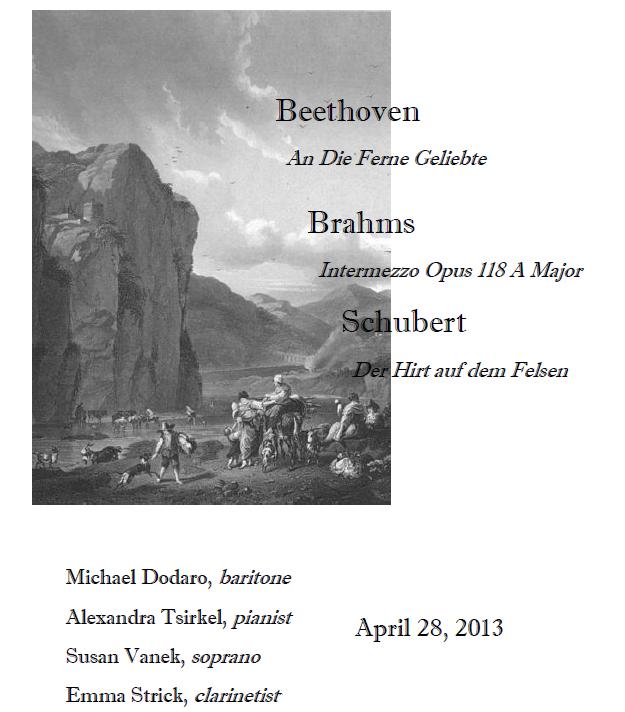
Audio tracks:
- An die Ferne Geliebte; Beethoven
- Intermezzo; Brahms Opus 118 A Major
- Der Hirt auf dem Felsen; Schubert
Wednesday, October 10, 2012
Beethoven-Eichberg-Welch
Ludwig van Beethoven
Hammerklavier Sonata for piano Opus 106
AllegroScherzo, Assai vivace
Adagio sostenuto
Largo - Allegro risoluto
 |
| Hartwig Eichberg, pianist |
Sonata for Cello and Piano in g minor Opus 5/2
Adagio sostenuto ed espressivo - Allegro molto piu tosto presto
Rondo. Allegro
 |
| Ron Welch, cellist - Hartwig Eichberg, pianist |
Luther Memorial Lutheran Church
Seattle, Washington
Thursday, July 26, 2012

Sunday, July 22, 2012
Hollywood Variety Show

Old Hollywood: Photos, Autographs, a Car, and Entertainment
Billed as the world's biggest collection of movie star photographs, the thousands of framed and autographed photos on display at Club Hollywood Casino in Shoreline, Washington, virtually define an era of glamour.
Collector Mark Mitchell, now 77, began pursuing the Hollywood stars for photos and autographs when he was 4 years old, thanks to his newspaperman father who interviewed and wrote stories about the stars. After Saturday-night gigs by front page stars such as Groucho Marx, the news staff brought their wide-eyed children on Sunday to meet the entertainers. When he was in his teens in Las Vegas, Mitchell got a napkin from the famed Sands Hotel in Vegas signed by Frank Sinatra.
Only a portion of his extensive collection is now displayed at Club Hollywood Casino, at 16716 Aurora Avenue North, with much more in his Seattle home. The collection also includes a large number of sports greats. Some of these photos are at Hamburger Harry’s in Ballard and Edmonds, where Babe Ruth and Ty Cobb keep tabs on the number of hamburgers sold.
Club Hollywood Casino was literally designed and built around a car owned by Marilyn Monroe, who purchased the vehicle not long before her early death. Bought by Mr. Mitchell some 35 years ago, the limousine was placed on site, and the building constructed around it, leaving it now sitting in the front window of Club Hollywood. Mitchell drove a generation of Little League ball players around in that car when he was a coach.
On Club Hollywood's upper floor rows of photos line every wall. John Wayne, Judy Garland, Clark Gable, Marlon Brando, Jimmy Steward, Elvis Presley, Rudolph Valentino, Sophia Loren, Marlena Dietrich, Goldie Hawn, Jean Simmons and thousands of others, gaze back at fascinated visitors. Although the collection focuses on Hollywood actors, there are also photos of some directors, producers, and musicians, along with a sports star who appeared in films…a memorable Mickey Mantle.
A show that features entertainment from the era of this photo collection opens at Club Hollywood on August 19 and returns on September 16. The Hollywood Variety Show includes songs, comedy, instrumental music, and magic. Frank Sinatra and Elvis Presley won't be there, but it will be fun to reminisce.
See these shows August 19 or September 16, both Sundays, at 3:30 pm at Club Hollywood. Tickets are $20 at the door.
Wednesday, May 23, 2012
Jeremiah Lawson, Guitarist and Composer
New Music by Jeremiah Lawson
Prelude in C minor
Fugue in C minor
Saturday, March 31, 2012

Thursday, March 1, 2012
Mondo Cane Theme - More
Lyrical theme from an edgy film: Mondo Cane
Song by Riz Ortolani and Nino Oliviero from the 1962 film (A world gone to the Dogs) .
Song by Riz Ortolani and Nino Oliviero from the 1962 film (A world gone to the Dogs) .
Tuesday, February 28, 2012
I've got the World on a String
This office is starting to sound like Las Vegas.
I've got the World on a String
Songwriters: BURKE, JOHNNY / JOHNSTON, ARTHUR
writers: Harold Arlen/ T. Koehler
I've got the World on a String
Songwriters: BURKE, JOHNNY / JOHNSTON, ARTHUR
writers: Harold Arlen/ T. Koehler
Wednesday, February 8, 2012
New York, New York
It's was a big orchestra for my office, but we managed.
New York, New York
Michael Dodaro, (Sinatra)
Songwriters: KANDER, JOHN/EBB, FRED
New York, New York
Michael Dodaro, (Sinatra)
Songwriters: KANDER, JOHN/EBB, FRED
Sunday, February 5, 2012
Monday, January 30, 2012
Sunday, November 20, 2011
Autumn Festival of Songs
Arabella, by Richard Strauss
Sarah Fletcher; Diane Althaus, Sopranos, Josh Brown, pianist

Warm as the Autumn Night, by Douglas Moore
Roland Ken Sabalza, baritone, Josh Brown, pianist
Don Giovanni; La ci darem la mano, by Mozart
Sarah Fletcher & Roland Ken Sabalza, Josh Brown, pianist

Danza de la moza donasa, by Ginastera
Josh Brown, pianist
Cavallaria Rusticana, Voi lo sapete, by Mascagni
Sarah Fletcher, Josh Brown, pianist
Linda di Chamounix, by Donizetti
Megan Chenovick, soprano, Josh Brown, pianist

.
Sarah Fletcher; Diane Althaus, Sopranos, Josh Brown, pianist

Warm as the Autumn Night, by Douglas Moore
Roland Ken Sabalza, baritone, Josh Brown, pianist
Don Giovanni; La ci darem la mano, by Mozart
Sarah Fletcher & Roland Ken Sabalza, Josh Brown, pianist

Danza de la moza donasa, by Ginastera
Josh Brown, pianist
Cavallaria Rusticana, Voi lo sapete, by Mascagni
Sarah Fletcher, Josh Brown, pianist
Linda di Chamounix, by Donizetti
Megan Chenovick, soprano, Josh Brown, pianist

.
Tuesday, October 11, 2011
Arts funding doesn't show diversity
Brett Zongker this morning in the Seattle Times cites a study by the Washington-based National Committee for Responsive Philanthropy:
"Billions of dollars in arts funding is serving a mostly wealthy, white audience that is shrinking while only a small chunk of money goes to emerging art groups that serve poorer communities that are more ethnically diverse, according to a report being released Monday."
The jist of it is an unsurprising assertion that the opera/ symphony crowd is grabbing too much of the money. What this slant evades completely is that BIG ARTs organizations get the money regardless of whether the art is that of dead white European males or of the kinds of organizations Zongker seems to favor:
Maurine Knighton, who leads the foundation's arts and culture programs, said changing the way foundations give grants is possible but will take time.
"You are dealing with shifting demographics that are fairly recent," and foundations will have to make a deliberate effort to catch up, Knighton said. "It's just a different way of considering how to be most effective with our grant dollars."
The Ford Foundation, a major arts funder that launched a $100 million initiative last year to develop spaces for diverse arts groups, has funded a dance center in New York's Chinatown, the New York Latino cultural center El Museo del Barrio, and community arts projects in Seattle, New Orleans, and elsewhere.
"There is no question that investing in a diverse array of arts and culture institutions is an important direction for funders," Darren Walker, the foundation's vice president for education, creativity and free expression, said in an e-mail. "In a country that is diversifying as fast as ours, it's even more important to lift up artistic voices that can help us understand who we are and who we are becoming."
Well, OK, diversity in cultural tradition counts for something, but dance centers and museums are useless while artists in these communities are working as waiters, employess in airport kitchens, and secretaries instead of performing for the local audience that is usurped by BIG ARTs organizations.
Government funding legitimizes established organizations and private funding follows it. A new opera or dance company founded by and for local artists faces debilitating competition from organizations that are already too powerful and taking not only the lion's share of funding but monopolizing the local audience as well. Indigeneous organizations can't afford to perform in the spaces built by "Ford's $100 million initiative last year to develop spaces for diverse arts groups."
Finally the money from government and private contributions in local communities that does trickle down to artists and performers goes to those who are represented by financially advantaged New York management, not local singers, dancers, or visual artists.
"Billions of dollars in arts funding is serving a mostly wealthy, white audience that is shrinking while only a small chunk of money goes to emerging art groups that serve poorer communities that are more ethnically diverse, according to a report being released Monday."
The jist of it is an unsurprising assertion that the opera/ symphony crowd is grabbing too much of the money. What this slant evades completely is that BIG ARTs organizations get the money regardless of whether the art is that of dead white European males or of the kinds of organizations Zongker seems to favor:
Maurine Knighton, who leads the foundation's arts and culture programs, said changing the way foundations give grants is possible but will take time.
"You are dealing with shifting demographics that are fairly recent," and foundations will have to make a deliberate effort to catch up, Knighton said. "It's just a different way of considering how to be most effective with our grant dollars."
The Ford Foundation, a major arts funder that launched a $100 million initiative last year to develop spaces for diverse arts groups, has funded a dance center in New York's Chinatown, the New York Latino cultural center El Museo del Barrio, and community arts projects in Seattle, New Orleans, and elsewhere.
"There is no question that investing in a diverse array of arts and culture institutions is an important direction for funders," Darren Walker, the foundation's vice president for education, creativity and free expression, said in an e-mail. "In a country that is diversifying as fast as ours, it's even more important to lift up artistic voices that can help us understand who we are and who we are becoming."
Well, OK, diversity in cultural tradition counts for something, but dance centers and museums are useless while artists in these communities are working as waiters, employess in airport kitchens, and secretaries instead of performing for the local audience that is usurped by BIG ARTs organizations.
Government funding legitimizes established organizations and private funding follows it. A new opera or dance company founded by and for local artists faces debilitating competition from organizations that are already too powerful and taking not only the lion's share of funding but monopolizing the local audience as well. Indigeneous organizations can't afford to perform in the spaces built by "Ford's $100 million initiative last year to develop spaces for diverse arts groups."
Finally the money from government and private contributions in local communities that does trickle down to artists and performers goes to those who are represented by financially advantaged New York management, not local singers, dancers, or visual artists.
Friday, September 30, 2011
La Boheme, duet Marcello, Mimi
Speravo di trovarvi qui
Sarah Fletcher, soprano - Ken Sabalza, baritone
Josh Brown, pianist
Fat Chance Opera, August 2011
See also: http://sarahfletchersoprano.blogspot.com/
Sarah Fletcher, soprano - Ken Sabalza, baritone
Josh Brown, pianist
Fat Chance Opera, August 2011
See also: http://sarahfletchersoprano.blogspot.com/
Subscribe to:
Posts (Atom)